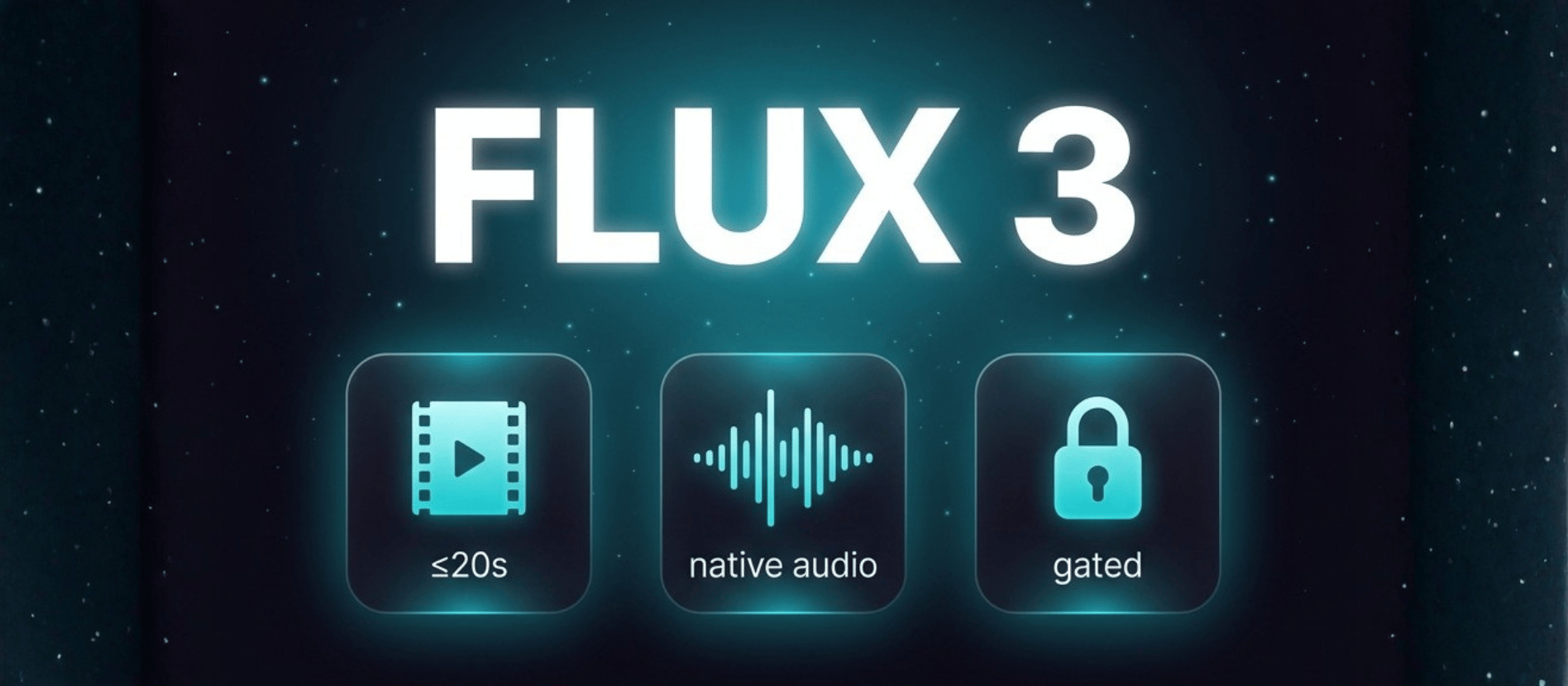
On July 23, 2026, Black Forest Labs announced FLUX 3 — one multimodal model trained jointly on image, video and audio, extendable to predicting robot actions. The headlines that followed were about 20-second clips with native sound. The part that got buried: you almost certainly cannot use it yet.
FLUX 3 Video and FLUX 3 Action went into a gated early access program. Anyone can apply; Black Forest Labs has to approve you. There is no public API and no published pricing. This post separates what BFL officially stated from what has actually been verified, and lays out — in conditional terms, because that is all the evidence supports — how we plan to approach FLUX 3 on ImagineToVideo.
Here is the announcement video Black Forest Labs published with it:
<video src="https://cdn.imaginetovideo.com/blog/content/flux3video.mp4" poster="https://cdn.imaginetovideo.com/blog/cover/flux-3.png" controls preload="none" style="max-width: 720px; width: 100%; aspect-ratio: 16 / 9; height: auto; object-fit: cover; display: block; margin: 1.5rem auto; border-radius: 12px; background: #000;"></video>
Official announcement video by Black Forest Labs, July 23, 2026. Every clip was rendered by BFL — none of it was generated on ImagineToVideo, and none of it has been independently reproduced.
What Black Forest Labs Announced
FLUX 3 is not a single model but a family, presented as a step toward what BFL calls a real-world model — one backbone that learns spatial structure, movement, sound and physical interaction together instead of treating each as a separate task.
| Variant | What it does |
|---|---|
| FLUX 3 Video | Video generation with optional native audio |
| FLUX 3 Image | Image synthesis and editing across styles, aspect ratios and resolutions |
| FLUX 3 Action (FLUX-mimic) | Video-action model for robot learning and dexterous manipulation |
| FLUX 3 Dev | Open-weight multimodal backbone for content creation and action prediction |
The underlying method is called Self Flow, described by BFL as its approach to aligning multimodal generation and understanding inside one system. Named early partners testing the model include Canva, Burda, Magnific (formerly Freepik), Krea and Picsart.
Black Forest Labs is a known quantity here — the FLUX image models are widely used, and FLUX.2 is a current production line. That track record is exactly why the video claims deserve a fair hearing, and exactly why they still need testing before anyone reorganises a workflow around them.
Availability: Read This Before the Specs
This is the section most coverage skipped, so it goes first.
| Variant | Stated availability |
|---|---|
| FLUX 3 Video | Gated early access — apply, wait for BFL approval |
| FLUX 3 Action | Gated early access, via selected research and commercial partners, starting with mimic robotics |
| FLUX 3 Image | "Coming weeks" |
| FLUX 3 Dev (open weights) | "Later this year" |
| Public API | ⚠️ None yet |
| Published pricing | ⚠️ None yet |
On pricing specifically: BFL's own pricing page still lists FLUX.2 models (klein 4B, klein 9B, pro, max, flex) and the FLUX.1 line. There is no FLUX 3 SKU, no per-second rate, no per-generation rate. Any FLUX 3 price quoted today has no official source behind it. If you see one in a comparison table, that table is guessing.
Announced ≠ preview ≠ beta ≠ generally available. FLUX 3 is at the first of those four stages for most people. Planning a production pipeline around it right now means planning around an approval queue you do not control.
The Claimed Capabilities
Everything in this table is what Black Forest Labs stated. None of it has been independently measured, because the model is not publicly released — there is no way for a third party to run it.
| Capability | Official claim | Verification level |
|---|---|---|
| Clip length | Up to 20 seconds in a single generation | ⚠️ Vendor claim, untested |
| Audio | Native audio generated with the video | ⚠️ Vendor claim, untested |
| Resolution | 720p cited for published evaluations | ⚠️ Vendor claim; no other resolutions disclosed |
| Text-to-video | Listed | ⚠️ Vendor claim, untested |
| Image-to-video | Listed (animation or reference) | ⚠️ Vendor claim, untested |
| Video-to-video | Listed | ⚠️ Vendor claim, untested |
| Video-audio continuation | Listed | ⚠️ Vendor claim, untested |
| Keyframe-to-video | Listed | ⚠️ Vendor claim, untested |
| Multilingual dialogue | Listed | ⚠️ Vendor claim, untested |
| Longer sequences | Via agentic chaining | ⚠️ Vendor claim; mechanism not detailed |
| Model size / parameters | Not disclosed | ⚠️ Undisclosed |
| Training data specifics | Not disclosed beyond "multimodal sources" | ⚠️ Undisclosed |
If the 20-second figure holds up in practice, it is genuinely notable — it is longer than a single take from any model we currently run. That is a real if, not a rhetorical one.
The Benchmark Numbers — and Why They Need an Asterisk
Black Forest Labs published preference win rates for FLUX 3 Video from what it describes as early evaluations:
| Comparison | Stated win rate for FLUX 3 |
|---|---|
| vs Grok | 69% |
| vs Kling v3 Pro | 60% |
| vs Runway Gen-4.5 | 77% |
| vs Luma Ray 3.2 | 93% |
⚠️ These are vendor self-reported results, not independent blind tests. BFL has not published the evaluation protocol, the sample size, the number of raters, or the prompt set. It also has not published image-model benchmarks at all.
None of that makes the numbers false. It makes them unverifiable, which is a different thing — and the correct response is to treat them as a claim awaiting a test rather than as a settled ranking.
We have been here recently. When Seedance 2.5 was previewed at a conference, a chunk of the coverage rewrote "preview" as "released," and one widely repeated spec turned out to belong to Seedance 2.0 rather than 2.5. Vendor slide claims and hands-on results are two different categories of evidence, and the gap between them is where most bad purchasing decisions live.
FLUX 3 Action and the Robotics Angle
The part of the announcement that has nothing to do with making video: FLUX 3 Action, also referred to as FLUX-mimic, extends the same backbone from generating frames to predicting actions — robot learning and dexterous manipulation, developed with mimic robotics.
Architecturally it is the more interesting claim. A model that has learned how objects move and interact well enough to predict a robot's next action is making a stronger statement about its world model than one that only produces convincing frames. It is also further from anything you can use in a browser, and it sits inside the same gated early access. Track it on the Black Forest Labs blog — it is outside what we do.
Our Integration Plan
We are not going to pretend a schedule exists. Here is the actual sequence, with the dependency stated plainly.
1. Wait for the official API and early access to open. There is nothing to integrate against right now. BFL has said API access, private model weights and the open-weight FLUX 3 Dev are planned for later this year.
2. Benchmark the real specifications against the claims. Clip length, whether audio holds up across languages, resolution ceiling, latency, failure modes, and how the output compares to Kling V3 and VEO 3.1 on the same prompts. We publish what we measure, including the parts that disappoint.
3. Convert published pricing into credits. We cannot price a model whose vendor has not priced it. Once BFL publishes rates, we work out what a FLUX 3 generation costs in credits and whether that is defensible next to what you already get.
4. Roll out gradually, then fully. A limited release first, then general availability, then a localized landing page — the same path Seedance 2.0 and Kling V3 took.
Two things we are deliberately not doing today: we have not added FLUX 3 to our model registry, and we are not committing to a date. The timing depends entirely on when Black Forest Labs opens the API and publishes pricing. If that slips, our plan slips with it, and we would rather say so now than quietly miss a date we invented.
What You Can Generate Today
While FLUX 3 sits behind an application form, these run right now on ImagineToVideo — all with native audio:
| Model | Duration | Resolution | Notes |
|---|---|---|---|
| Kling V3 | 3–15s | 720p / 1080p | Longest single takes we offer; strong camera motion |
| Kling V3 Omni | 3–15s | 720p / 1080p | Multi-shot consistency across connected scenes |
| VEO 3.1 | 4 / 6 / 8s | 720p / 1080p | Best for spoken dialogue in a single prompt |
| VEO 3.1 Fast | 4 / 6 / 8s | 720p / 1080p | Faster, cheaper drafts |
| Seedance 2.0 | 5–15s | 480p / 720p | Includes video-to-video |
| Seedance 2.0 Fast | 5–15s | 480p / 720p | Faster turnaround |
A practical note if you are planning around FLUX 3 anyway: write your prompts with the shot description, spoken lines and ambient sound in one block. Every audio-native video model reads prompts that way — the ones running today, and the one FLUX 3 claims to be. Prompts written like that carry over when FLUX 3 opens up, which turns waiting into preparation.
Start at text to video, or see Seedance 2.0 for the video-to-video path. We keep a running status page for FLUX 3 at our FLUX 3 guide — it is updated as availability changes.
FAQ
When will FLUX 3 be publicly available? Black Forest Labs has not given a public date. FLUX 3 Video and FLUX 3 Action are in gated early access now, FLUX 3 Image is described as coming in the following weeks, and API access plus the open-weight FLUX 3 Dev are planned for later this year. Those are the company's own words, not a schedule anyone has committed to.
What exactly did Black Forest Labs claim for FLUX 3? Up to 20 seconds in a single generation with natively generated audio, evaluated at 720p, covering text-to-video, image-to-video, video-to-video, video-audio continuation, keyframe-to-video, multilingual dialogue and agentic chaining for longer sequences — all built on a method it calls Self Flow. Every item on that list is a vendor claim; the model has not been publicly released, so none of it has been independently measured.
Are the FLUX 3 win rates against Kling, VEO, Runway and Luma independently verified? No. The published figures — 69% against Grok, 60% against Kling v3 Pro, 77% against Runway Gen-4.5 and 93% against Luma Ray 3.2 — are self-reported preference results from Black Forest Labs. The company has not published its evaluation protocol, sample size, rater count or prompt set, and has published no image-model benchmarks at all. Treat them as a vendor claim pending hands-on comparison.
Does FLUX 3 have an API or published pricing yet? Neither. BFL says API access, private model weights and the open-weight FLUX 3 Dev are planned for later this year, but nothing is live. Its pricing page still covers only the FLUX.2 and FLUX.1 lines — there is no FLUX 3 SKU and no per-second or per-generation rate, so any FLUX 3 price circulating today has no official source.
Will ImagineToVideo support FLUX 3 — and what can I use in the meantime? We plan to evaluate integration once the official API and pricing are public, benchmark the real specifications against what has been claimed, and then price it in credits. The timing depends on when Black Forest Labs opens the API and publishes pricing, so we are not committing to a date, and FLUX 3 is not in our model registry today. In the meantime Kling V3 and Kling V3 Omni (3–15 seconds, 720p/1080p), VEO 3.1 and VEO 3.1 Fast (4/6/8 seconds, 720p/1080p) and Seedance 2.0 and Seedance 2.0 Fast (5–15 seconds, 480p/720p, video-to-video included) are all available with native audio and no approval step.