Update — August 7, 2026. This preview has since been overtaken by good news, and its cautious calls held up. Seedance 2.5 officially shipped on July 31, 2026, its public API went live in early August (served by FAL), and it now runs on ImagineToVideo as the default model. The 4K skepticism below proved right: the live API outputs 480p/720p only. The FAQ has been refreshed to the live facts; the body below stands as the June 23 preview record.
On June 23, 2026, at the Volcano Engine FORCE conference in Beijing, ByteDance pulled the cover off its next-generation video model: Seedance 2.5. The number is a deliberate signal — ByteDance skipped 2.1 through 2.4 entirely and jumped straight from Seedance 2.0 to 2.5, framing it as a generational leap rather than a point release.
One thing to be clear about up front, because a lot of the headlines today get it wrong: Seedance 2.5 was previewed, not shipped. ByteDance announced it on stage, said it is currently in (enterprise) beta, and set the official public launch for early July 2026. Several Chinese outlets ran "officially released" in their titles, but the body text in every one of those same reports points to an early-July launch and ongoing testing. So treat today as the unveiling — the model is coming, it just isn't broadly available yet.
This post is a forward-looking preview: what ByteDance is claiming, what is still unconfirmed, how 2.5 compares to the Seedance 2.0 you can already use on ImagineToVideo, and our plan for bringing 2.5 to the platform once the official API opens.
The three headline claims
ByteDance led with three capabilities it described as industry firsts. We're presenting them as the company's own claims — none have been independently benchmarked yet, because the model isn't out.
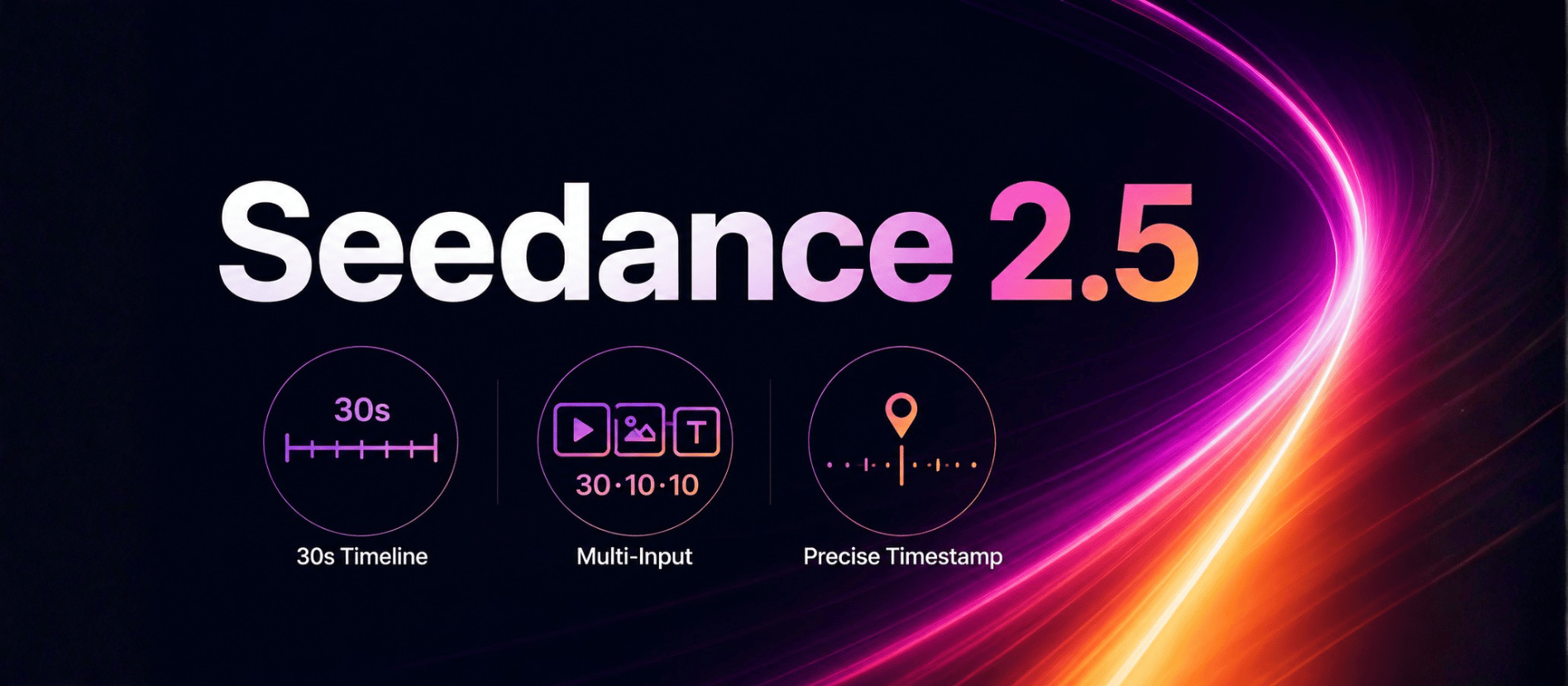
1. 30-second native video in a single segment
Seedance 2.5 is claimed to generate a single continuous 30-second clip directly, without stitching shorter segments together. For context, most competitors today top out in the few-seconds-to-15-seconds range per generation. If this holds up under real testing, it meaningfully changes what you can do in one pass — full ad spots, longer narrative beats, complete dance sequences — without the seams and drift that come from concatenating clips.
2. Up to 50 multimodal reference inputs
The model is claimed to accept up to 50 reference materials — images, video, and text combined — for a single joint generation, which ByteDance says is the highest in the industry. Seedance 2.0 already supports multi-reference workflows; pushing the ceiling this high is aimed at consistency-heavy use cases: keeping a character, product, or art style locked across a long shot, or compositing many source elements into one coherent scene.
3. Flexible local / regional editing
Seedance 2.5 is claimed to support editing part of a frame while keeping the rest consistent — change one region, element, or subject without re-rolling the entire generation. This is the kind of targeted control creators have been asking for: fix the one thing that's wrong instead of regenerating and hoping the good parts survive.
Reality check: All three are ByteDance's stated capabilities from the FORCE keynote. They are plausible and consistent across the reporting, but they have not been verified by third parties or independent benchmarks. We'll revisit them with hands-on testing once 2.5 is publicly available.
Seedance 2.0 → 2.5: what actually changes
Here's the upgrade story, with unconfirmed items flagged honestly:
| Dimension | Seedance 2.0 (available today) | Seedance 2.5 (preview) |
|---|---|---|
| Max single-clip duration | 4–15 seconds | ~30 seconds, single segment (claimed) |
| Reference inputs | up to ~12 assets | up to 50 multimodal references (claimed) |
| Local/regional editing | limited | flexible region editing (claimed, new) |
| Resolution | up to 2K class (4K added in a parallel 2.0 upgrade*) | Not officially disclosed for 2.5 ⚠️ |
| Frame rate | standard | Not disclosed ⚠️ |
| Native audio / lip-sync | yes (single-pass audio + lip-sync) | Not separately confirmed for 2.5 ⚠️ |
| API pricing | published on provider platforms | Not disclosed ⚠️ |
| Benchmark rank | leads several Artificial Analysis categories | Not benchmarked (unreleased) ⚠️ |
*At the same FORCE event, ByteDance announced a native 4K upgrade for Seedance 2.0. Note that most reliable reporting attributes the 4K upgrade to 2.0, not 2.5 — 2.5's resolution spec was not officially disclosed. A couple of aggregated summaries lumped "native 4K + 10-bit" under 2.5; we're treating 2.5's resolution as unconfirmed until ByteDance publishes a spec sheet.
The defensible, no-hype version of the upgrade: duration 15s → 30s, references 12 → 50, plus new region-level editing control. Everything beyond that is currently undisclosed.
The bigger picture: ByteDance's FORCE 2026 lineup
Seedance 2.5 didn't ship alone. At the same event ByteDance rolled out a coordinated wave of model upgrades, which is useful context for where 2.5 fits:
- Seedance 2.0 — native 4K upgrade (the existing video model gets a resolution bump)
- Seed-Audio 1.0 — a dedicated audio model (multi-character dialogue, background music, sound effects)
- Seedream 5.0 Pro — the image generation line
- Doubao 2.1 Pro — the flagship LLM, with aggressive token pricing
ByteDance also positioned Seedance 2.5 toward industrial verticals — embodied intelligence, manufacturing, and autonomous driving (data synthesis and scene simulation) — alongside the creative use cases. That's a signal the model is being pushed as infrastructure, not just a consumer toy.
How 2.5 stacks up against Veo and Kling — honestly
It's too early for a real head-to-head, so here's the fair framing rather than a winner's bracket:
- Where 2.5 looks differentiated: single-segment 30-second generation and the 50-reference ceiling are genuinely aggressive numbers. If they survive contact with real prompts, that's a strong story for long-form and consistency-critical work.
- Where it's still a question mark: resolution and pricing are undisclosed, and there's no benchmark data. Veo 3.1 and Kling V3 are known, shipping, measurable quantities today. Seedance 2.5 is a promise with a July date on it.
Bottom line: 2.5 is one to watch closely, not one to plan production around yet.
Our integration roadmap
ImagineToVideo already runs Seedance 2.0 and Seedance 2.0 Fast — you can use them right now at /seedance for text-to-video, image-to-video, and reference-to-video. So bringing 2.5 online is an extension of a model family we already support, not a from-scratch integration.
Here's how we plan to approach it (deliberately phrased as a plan, because the timeline depends on ByteDance, not us):
- Wait for the official launch. 2.5 is in beta with an early-July target. We'll evaluate once the Volcano Engine API — and third-party providers like FAL and Replicate — open access.
- Validate the real specs. We'll test the actual resolution, duration, audio behavior, and per-second cost against ByteDance's claims before committing to anything user-facing.
- Calibrate credit pricing. Seedance 2.5's API pricing hasn't been disclosed. Once it is, we'll map it to a fair credit cost the same way we did for Seedance 2.0 — no surprises.
- Roll out gradually. Plan is a small gated release first, then wider availability, then localized landing pages across all supported languages.
We're not committing to a specific date, because the gating factor is when the official API and pricing land. What we can say: 2.5 is on our radar, it's a natural fit for the Seedance experience we already run, and we'll publish progress here as it firms up.
What you can do today
You don't have to wait for 2.5 to make great video. Seedance 2.0 is live on ImagineToVideo right now — strong motion quality, native audio, multi-reference workflows, and both a Quality and a Fast tier so you can iterate cheaply and render clean. Start at /seedance.
We'll update this post — and ship a fresh deep-dive — the moment Seedance 2.5 is publicly available and we've put it through real testing.
FAQ
When can I actually use Seedance 2.5? Now. Seedance 2.5 was officially released on July 31, 2026, its public API went live in early August (served by FAL), and since August 7, 2026 you can generate with it directly on ImagineToVideo, where it is the default model.
What's the real difference from Seedance 2.0? The shipped differences: single-pass duration up to 30 seconds (vs 4-15 for 2.0), lip-synced dialogue generated from quoted lines in the prompt, and a larger reference budget at the API level. One preview-era unknown resolved the other way: 2.5 outputs 480p/720p only, while Seedance 2.0 still offers a 1080p tier.
Does Seedance 2.5 do native 4K? No — this preview-era caution proved correct. The live API schema offers 480p and 720p only, with no 1080p or 4K tier. The native 4K upgrade announced at FORCE 2026 belonged to Seedance 2.0, and no 4K claim should be attached to 2.5.
How much will it cost? Pricing is now public: FAL serves the API at $0.0214 per 1,000 tokens — roughly $0.47 per second at 720p and $0.22 at 480p with audio. On ImagineToVideo it is priced in credits by duration and resolution, exactly the calibrate-after-official-rates approach this post described.
When will ImagineToVideo support Seedance 2.5? It happened on August 7, 2026 — the roadmap in this post played out as written: the official API opened (via FAL), we validated the real specs against the claims, calibrated credit pricing, and rolled it out. Seedance 2.5 is now the default model, with Seedance 2.0 and 2.0 Fast still available.